
A technology risk assessment that helps organizations identify, measure, and manage key risks and controls insurers evaluate.
This assessment captures risk control nuance beyond traditional yes/no applications and translates it into a structured risk profile and underwriting-ready narrative. This supports more efficient submissions, a clearer renewal strategy, and year-over-year control improvement.
What you’ll receive after completing the Technology Risk Compass:
- Compass Score: An overall risk control rating
- Compass Report: Category-by-category results across 8 control domains, with question-level risk ratings and underwriting “why it matters” insight
- Compass Roadmap: Resources and tools to help you implement stronger controls
The Technology Risk Compass gives you clarity into your current risk posture, actionable improvements for your internal controls, a stronger story to tell underwriters, a more stable long-term insurance cost trajectory, and fewer disruptive claims.
Access the Risk CompassThe Benefits for Your Organization
-
Stronger Internal Controls
- The assessment highlights strengths and gaps, allowing your team to proactively enhance policies, processes, and governance frameworks.
-
Fewer Disruptive Claims
- Stronger controls reduce the frequency and severity of incidents, lowering operational downtime and financial losses.
-
A More Resilient Business
- Resilience is built through disciplined controls, clear ownership, and continuous improvement. The assessment supports continuous improvement that strengthens long-term organizational performance.
-
Better Insurance Outcomes
- Underwriters respond favorably to organizations that can clearly demonstrate robust controls. Better clarity leads to more competitive pricing, broader coverage, fewer exclusions, and faster quoting. This reduces dependence on market cycles and strengthens your negotiating position.
-
A Management-Ready Risk Profile
- The assessment produces a board-ready report that can be shared internally to align leadership around strategic risk priorities, formatted for leadership review and audit/risk committee reporting.
Axis Proprietary Risk Methodology
Our industry-leading process combines a secure, SaaS-based platform workflow with a senior advisory review, structured in two parts with two steps each. We assess your key risk controls then validate control maturity. From there, we prioritize risks by severity, likelihood, and operational dependency based on your businesses characteristics and build a practical improvement roadmap supported by best practice suggestions, and a suite of tools and resources. This translates your results into a clearer underwriting narrative and improved business resiliency.
read more about our risk methodology and assessment here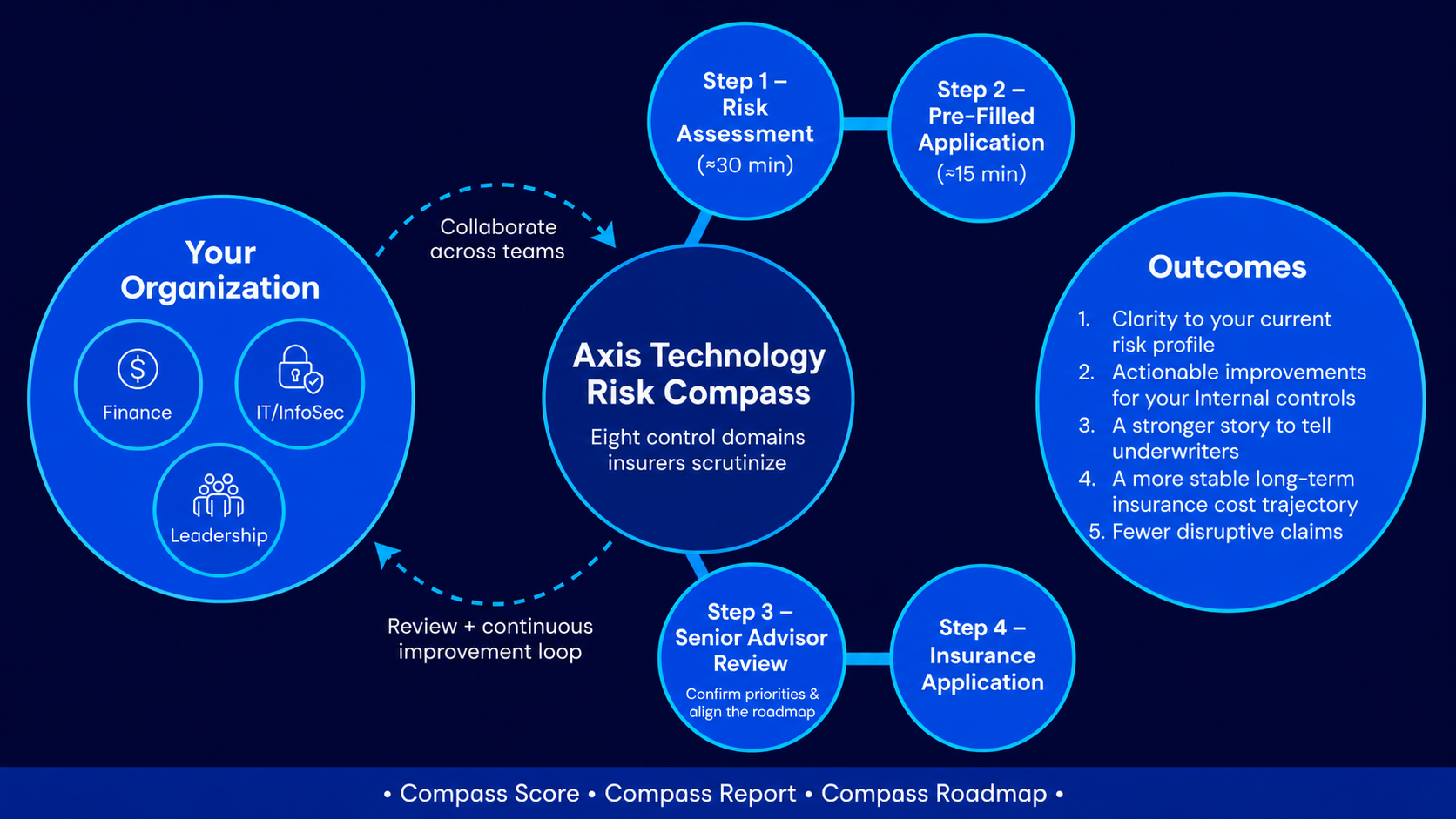
Navigate Your Risk Today
Gain clarity on your risk profile. Connect with our team to access the Risk Compass and receive your Compass Score and Report.
Access the Risk CompassFrequently Asked Questions
The assessment works best when it is coordinated by an executive who can pull in targeted input from the right functions. In most technology organizations, that executive is typically the CEO, CFO, CISO/Head of IT, COO, or another senior leader. We recommend involving security/IT for control maturity and resilience practices, operations for process dependencies and vendor oversight, and legal/compliance for contractual and governance considerations. The goal is not perfect “policy language,” but an accurate view of how controls operate in practice so the resulting risk profile and roadmap are meaningful and defensible.
Most organizations complete the risk assessment in approximately 30 minutes. If you choose to proceed to the insurance application workflow, the follow-on application step typically takes about 15 minutes because the platform pre-populates information already captured in the assessment. If multiple stakeholders are contributing, or if your organization has more complex operations (international footprint, regulated customers, public-company governance), the process may take longer to complete, but your progress is saved so you can pause and return at any time. After completion, many organizations also schedule a 30-minute principal-led review to validate context and align priorities with the operating plan and renewal timeline.
The assessment is designed to capture the depth and nuance of your internal controls through structured questions rather than forcing simple yes/no answers. That said, the process is most efficient when the person completing the assessment has access to basic information about your technology and governance posture, high-level security and resilience practices, vendor management approach, and any key operational or compliance requirements that shape how your organization manages risk. If certain details are owned by other functions, you can complete what you know, pause, and return once you have the right inputs.
No. The risk assessment is appropriate for both existing Axis clients and organizations evaluating Axis as a risk advisor and insurance broker. If you are exploring a new relationship, the assessment allows Axis to understand your operating environment and emerging risks in a structured way, and it gives you a clear internal snapshot of control strengths and gaps before any placement decisions are made. If you later request quotations, the same structure helps present your controls to underwriters more clearly.
Completing the Risk Compass does not bind coverage. The assessment is designed to produce a management-ready risk profile and roadmap, and it can also streamline the underwriting process by helping prepare a clearer, more complete submission narrative. If you choose to proceed with quotations or placement, the platform can support an insurance application step by pre-populating information already captured in the assessment; however, coverage is only bound when you instruct Axis to proceed and an insurer confirms binding terms in writing.
Axis treats assessment information as confidential and does not sell, trade, or rent personal information. If you request quotations, indications of premium, policy terms, availability of coverage, or binding of insurance, Axis may share the information necessary to provide those services with insurance companies, underwriters, and other parties involved in the quoting/placement process, as outlined in Axis’s Privacy Policy.
Yes, you can navigate to your profile to view assessments in progress. Our platform is designed to be efficient and self-guided, and your progress is saved so you can stop and return at any time. Once completed, the platform generates an instant, board-ready risk assessment report summarizing strengths, vulnerabilities, and recommended areas of focus, and it can carry your responses forward into the application workflow to reduce duplication.
The assessment is built to capture and organize the kinds of complexity that often emerge with cross-border operations and capital markets exposure. For international operations, it can help uncover cross-jurisdiction contractual and regulatory considerations, vendor and supply-chain dependencies, and cross-border data governance in a way that supports a consistent underwriting narrative. For IPO readiness and public-company environments, it supports stronger governance by reinforcing incident escalation discipline, material change/material event decisioning, and risk reporting structures that align with audit/risk committee expectations. Following completion, a principal-led Axis review is used to validate context and align priorities with your growth plan, renewal timeline, and governance requirements.
The Axis Technology Risk Compass is not a formal audit, certification, or legal opinion. It is a structured risk assessment designed to help your organization understand control maturity, identify priority improvements, and prepare a clearer underwriting narrative.